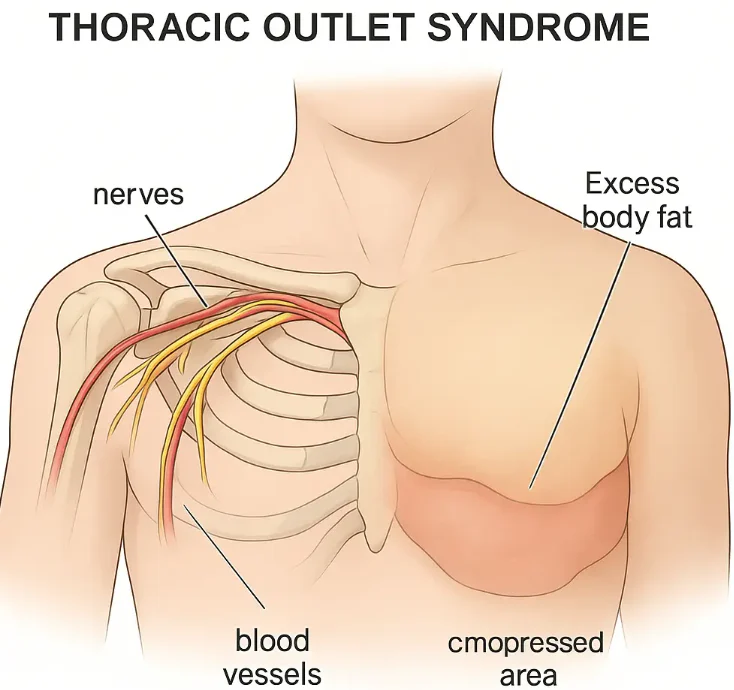
Thoracic Outlet Syndrome (TOS) occurs when nerves or blood vessels in the space between the collarbone and first rib become compressed. This can produce pain, numbness, tingling, or weakness that travels into the neck, shoulder, arm, or hand.
TOS can develop from poor posture, repetitive overhead activity, muscular tightness in the scalenes or pectoralis minor, or structural variations such as a cervical rib. Because both mechanical and inflammatory factors are usually involved, management typically addresses both.
At Cold Laser Perth, low-level laser therapy (LLLT) may be used as part of a broader management approach to help reduce nerve irritation and soft tissue tension in the thoracic outlet region. This blog explains what TOS involves, what the research shows about LLLT for neck and shoulder pain, and how we approach it clinically.
Common Symptoms of TOS
Symptoms vary depending on whether nerves or blood vessels are mainly affected. They can include:
- Pain, tingling, or numbness travelling down the arm or into the hand
- Weakness or heaviness in the affected arm
- Shoulder or neck discomfort, particularly when raising the arms overhead
- Postural fatigue or tightness through the chest and upper back
- Coldness or colour change in the hand in cases involving vascular compression
Symptoms often worsen with prolonged overhead work, carrying heavy bags on one shoulder, or sustained poor posture.
How Cold Laser Therapy May Help
Cold laser therapy delivers specific wavelengths of light energy into the affected tissues. At a cellular level, this is thought to support mitochondrial function, reduce pro-inflammatory cytokines, and promote tissue repair without generating heat.
In the context of TOS, laser therapy may assist by:
- Reducing irritation in the nerves passing through the thoracic outlet, including the brachial plexus
- Decreasing local soft tissue inflammation that contributes to compression
- Improving circulation in the surrounding tissue to support recovery
- Helping relax chronically tight muscles such as the scalenes and pectoralis minor that narrow the outlet space
It is important to note that LLLT is not a standalone treatment for TOS. The underlying mechanical contributors, including posture, muscle balance, and joint mobility, need to be addressed alongside any passive therapy.
What the Research Shows
There is no published research examining LLLT specifically for thoracic outlet syndrome. The studies below relate to LLLT for neck pain, shoulder pain, and neuropathic pain more broadly, which share some of the tissue types and mechanisms involved in TOS.
LLLT for neck pain: Chow et al., 2009 (The Lancet)A systematic review and meta-analysis published in The Lancet (Chow et al., 2009) analysed 16 randomised controlled trials involving 820 patients with acute or chronic neck pain. The review found that LLLT reduced pain intensity immediately after treatment in acute neck pain, and that the benefit persisted for up to 22 weeks after the end of treatment in chronic neck pain. The authors noted that side effects were mild and comparable to placebo.
LLLT for myofascial neck pain: Tehrani et al., 2022 (Lasers in Medical Science)A systematic review and meta-analysis published in Lasers in Medical Science (Tehrani et al., 2022) reviewed 13 randomised controlled trials on LLLT for myofascial neck pain. Pooled results showed that LLLT produced significant reductions in pain intensity and improvements in pressure pain threshold and range of motion. The authors noted that disability outcomes did not improve significantly, and recommended combining LLLT with manual therapy and exercise for best results.
LLLT and neuropathic pain: de Andrade et al., 2016 (Journal of Photochemistry and Photobiology B)A systematic review published in the Journal of Photochemistry and Photobiology B (de Andrade et al., 2016) reviewed the use of LLLT for neuropathic pain across both experimental and clinical studies. The experimental studies showed more consistent positive results than the clinical studies, and the authors concluded that while LLLT shows promise for pain modulation, the clinical evidence remains inconclusive due to variability in laser parameters across studies. More research with standardised protocols is needed.
MLS laser for chronic neck pain: Alayat et al., 2017 (Photomedicine and Laser Surgery)A randomised placebo-controlled trial published in Photomedicine and Laser Surgery (Alayat et al., 2017) compared multiwave locked system (MLS) laser therapy, single-wavelength LLLT, and placebo laser in 75 patients with chronic neck pain, all combined with exercise. Both active laser groups produced greater reductions in pain and improvements in neck disability index scores compared to placebo plus exercise, with the MLS group showing the strongest results.
How We Approach TOS at Cold Laser Perth
Management of TOS typically involves several components working together:
- Cold laser therapy targeting the scalene region, clavicular space, and pectoralis minor to help reduce local inflammation and nerve irritation
- Chiropractic and manual therapy to improve thoracic and cervical joint mobility and address postural contributors
- Rehabilitation exercises focused on deep neck flexor activation, scapular stabilisation, and postural correction
- Ergonomic and lifestyle advice around workstation setup, avoiding prolonged overhead postures, and load management
The combination of passive therapy with active rehabilitation is generally where the best outcomes are found for TOS and similar presentations.
Book an Appointment
If you are experiencing arm numbness, shoulder pain, or tingling that worsens with activity or overhead movement, it may be worth having this assessed.
At Cold Laser Perth, located within Lakeside Chiropractic in Joondalup, our practitioners combine laser therapy, manual care, and rehabilitation to support your recovery and improve function.
📍 Find us in Joondalup
📅 Book online: https://www.coldlaserperth.com.au/
📞 Call: (08) 9300 0095
Serving Perth's Northern Suburbs Cold Laser Perth proudly serves the City of Joondalup and surrounding suburbs including Yanchep (6035), Tapping (6065), Carramar (6031), Currambine (6028), Wanneroo (6065), Heathridge (6027), Edgewater (6027), Gnangara (6077), Mullaloo (6027), Padbury (6025), Kingsley (6026), Woodvale (6026), Banksia Grove (6031), and Duncraig (6023).
References
Chow RT, Johnson MI, Lopes-Martins RA, Bjordal JM. Efficacy of low-level laser therapy in the management of neck pain: a systematic review and meta-analysis of randomised placebo or active-treatment controlled trials. The Lancet. 2009;374(9705):1897-1908. https://pubmed.ncbi.nlm.nih.gov/19913903/
Tehrani MR, Nazary-Moghadam S, Zeinalzadeh A, et al. Efficacy of low-level laser therapy on pain, disability, pressure pain threshold, and range of motion in patients with myofascial neck pain syndrome: a systematic review and meta-analysis of randomized controlled trials. Lasers in Medical Science. 2022;37(9):3333-3341. https://pubmed.ncbi.nlm.nih.gov/35962884/
de Andrade ALM, Bossini PS, Parizotto NA. Use of low-level laser therapy to control neuropathic pain: a systematic review. Journal of Photochemistry and Photobiology B: Biology. 2016;164:36-42. https://pubmed.ncbi.nlm.nih.gov/27639607/
Alayat MS, Elsoudany AM, Ali ME. Efficacy of multiwave locked system laser on pain and function in patients with chronic neck pain: a randomized placebo-controlled trial. Photomedicine and Laser Surgery. 2017;35(8):450-455. https://pubmed.ncbi.nlm.nih.gov/28783464/

Dr. Kaitlyn (Yun Qi) Lau
I was first introduced to the world of Chiropractic in my teenage years, when I was given the opportunity to observe my cousin who is a chiropractor. During my brief time in observation, I witnessed the wonder of chiropractic and it was truly a miracle to me, seeing how it can change a person’s life. An old lady came in limping with chronic pain, after the treatment, she walked out perfectly fine with a big smile on her face. She held onto my hand to say thank you to me, even though I was just standing there doing nothing. It filled with me with such joy and fulfillment that in that instance, I made up my mind to become a chiropractor, no matter what it took. I graduated from Murdoch University with Distinction honours in 2016. During these 5 years at University, I participated in a 2 week placement in Northern India, called “Hands on India”, helping to raise over $80,000 to assist the communities living in poverty there, in return, I gained a wealth of knowledge and I was humbled by the amazing people there. In my role at Lakeside Chiropractic, I endeavor to provide excellent Chiropractic care and health advice to our community. I keep myself current with the best available research and professional development opportunities. I absolutely love being a Chiropractor and find that one of the most rewarding parts is being able to assist my patients in expressing their optimal health. My special interests are cervicogenic migraine, TMJ and sciatic pain. I especially love helping our moms-to-be achieve their best shape along the journey, this lead me to recently attended seminars for women’s fertility and pregnancy care essentials. Outside of the clinic, I enjoy my routine of going to yoga and pilates 3 times a week, as well as being a couch potato in front of TV with family. Born and raised in Malaysia, I am also fluent in Cantonese and Mandarin.
Latest Posts

Cold Laser Therapy for Morton's Neuroma in Perth
July 28, 2026

