Cold Laser Therapy for Morton's Neuroma in Perth

That sharp, burning pain between your toes, the one that feels like you're standing on a pebble or a bunched-up sock even when there's nothing there. If that sensation is familiar, you may be dealing with Morton's neuroma. It's one of those conditions that doesn't look like much from the outside but can make every step genuinely uncomfortable. And because it tends to worsen gradually rather than arriving with a sudden injury, a lot of people put up with it far longer than they need to.
At Cold Laser Perth, located within Lakeside Chiropractic in Joondalup, low-level laser therapy (LLLT) is one of the tools we use to address the nerve irritation and surrounding tissue inflammation that contribute to Morton's neuroma symptoms. This post covers what the condition is, how laser therapy may help, and what a full management plan looks like.
What Is Morton's Neuroma?
Morton's neuroma is a thickening of the tissue surrounding the digital nerve that runs between the metatarsal bones of the foot, most commonly between the third and fourth toes, though the second and third interspace is also frequently affected. The term 'neuroma' is a bit of a misnomer. It's not a true tumour but rather a perineural fibrosis, a fibrous thickening of the nerve sheath caused by chronic compression and irritation. (1)
Over time, this fibrotic tissue presses on the nerve itself, causing the characteristic burning, sharp, or electric-like pain that radiates into the toes. Some people also describe numbness or tingling in the affected toes, or a sensation that something is lodged under the ball of the foot.
It affects women more commonly than men, partly due to footwear choices. Narrow toe boxes and high heels both compress the metatarsal heads and increase intermetatarsal pressure. (2) That said, it's also common in runners, dancers, and anyone spending long hours on hard surfaces.
Common Symptoms
- Burning or sharp pain in the ball of the foot, often between the third and fourth toes
- Sensation of a pebble or fold in the sock under the forefoot
- Tingling or numbness radiating into the affected toes
- Pain that worsens with tight footwear, high heels, or prolonged walking and standing
- Relief when barefoot or when the foot is rested and offloaded
Morton's neuroma can be confused with plantar fasciitis, metatarsal stress fractures, or intermetatarsal bursitis. A clinical assessment helps distinguish between them, as each requires a different treatment approach.
How Cold Laser Therapy May Help
The photobiomodulation mechanism of cold laser therapy is particularly relevant for Morton's neuroma because the condition involves both nerve irritation and local inflammatory change in the perineural tissue, both of which LLLT acts on directly. (3)
At a cellular level, laser energy is absorbed by mitochondria in the affected tissues, triggering increased ATP production, reduced oxidative stress, and modulation of pro-inflammatory cytokines. For a nerve-related condition like Morton's neuroma, the relevant effects include:
- Reduction of perineural inflammation, decreasing the inflammatory response in the tissue surrounding the compressed nerve
- Nerve pain modulation, with research showing LLLT can reduce neuropathic pain in peripheral nerve conditions (3)
- Improved local microcirculation, enhancing blood flow to the metatarsal region and reducing hypoxia in chronically irritated nerve tissue
- Support for nerve recovery, with animal studies demonstrating that low-power laser irradiation applied to injured peripheral nerves can support functional recovery and regeneration (4)
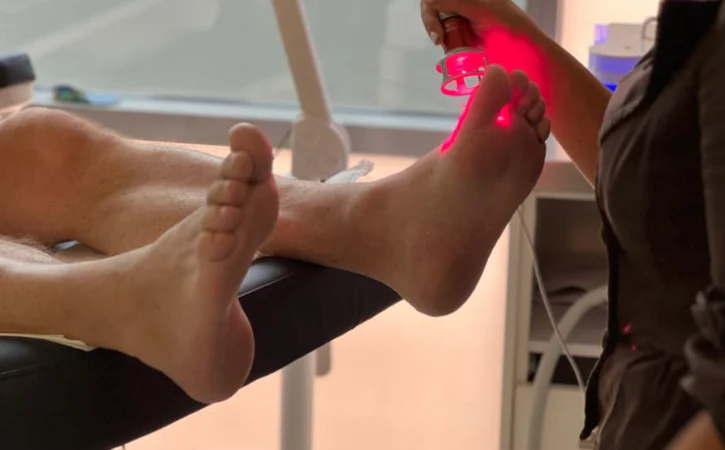
Sessions are applied directly to the forefoot over the affected intermetatarsal space. Treatment is painless and typically takes 5 to 10 minutes per session. Improvement builds over a course of treatment rather than from a single session.
What Does the Research Show?
Direct research on LLLT for Morton's neuroma is limited, which is common for more specific foot conditions. The available evidence comes from related nerve and neuropathic pain conditions, alongside mechanistic research on photobiomodulation and peripheral nerve tissue.
A systematic review published in Diabetes & Metabolic Syndrome found that LLLT produced meaningful reductions in neuropathic pain, with authors noting its potential as a conservative treatment option for peripheral nerve pain conditions. (3)
A study published in Lasers in Surgery and Medicine examined the effects of low-power laser irradiation on crushed peripheral nerve recovery in rats and found that laser-treated nerve tissue showed significantly improved electrophysiologic activity compared to control groups, suggesting a direct positive effect on peripheral nerve recovery. (4)
For the broader context of LLLT and foot pain, the evidence base for related conditions including plantar fasciitis and Achilles tendinopathy consistently supports LLLT as a useful conservative tool for foot and lower limb pain. (5)
While the Morton's neuroma-specific evidence base continues to develop, the combination of mechanistic plausibility and the established evidence in related nerve and foot conditions makes LLLT a reasonable conservative option, particularly for patients who have not responded adequately to footwear modification and orthotics alone.
How We Approach Morton's Neuroma at Cold Laser Perth
Morton's neuroma responds best to a combined approach that addresses both the immediate nerve irritation and the biomechanical factors driving the compression. At Cold Laser Perth, this typically includes:
- Cold laser therapy, applied to the affected intermetatarsal space to reduce perineural inflammation and support nerve recovery
- Chiropractic and manual therapy, with Lakeside Chiropractic assessment of foot biomechanics, metatarsal joint mobility, and load distribution to address the mechanical contributors to nerve compression
- Footwear advice, wide toe box footwear and avoiding high heels significantly reduces intermetatarsal compression, and this is often the single most impactful self-management step
- Metatarsal pad or orthotic support, offloading the affected interspace reduces direct pressure on the neuroma during standing and walking
- Activity modification, identifying and adjusting activities that aggravate symptoms while maintaining function where possible
- Soft tissue therapy, manual soft tissue work to the intrinsic foot muscles, interosseous muscles, and plantar fascia can help reduce metatarsal compression
For patients where conservative care does not provide adequate relief, the next steps typically involve corticosteroid injection or, in refractory cases, surgical neurolysis or excision. Conservative management with cold laser and manual therapy is worth pursuing before escalating to these options, as many patients respond well with conservative care. (2)
When to Seek Assessment
If you've been dealing with forefoot pain, burning between the toes, or that persistent 'pebble underfoot' sensation, particularly if it's been going on for more than a few weeks or is interfering with walking or footwear, it's worth getting a proper assessment to confirm what's going on.
Conditions like nerve-related foot pain, stress fractures, and intermetatarsal bursitis can all present similarly to Morton's neuroma, and treatment differs significantly between them. A clinical examination, sometimes supported by ultrasound, is needed to distinguish.
Frequently Asked Questions
How many cold laser sessions will I need for Morton's neuroma? This varies from person to person and depends on how long symptoms have been present and how much nerve irritation is involved. Improvement tends to build over a course of treatment rather than after a single session. Your practitioner will give you a clearer idea once they have assessed your foot.
Does cold laser therapy hurt? No. The laser is applied to the skin over the affected area and most people feel nothing more than a mild warmth, if anything. Each session over the forefoot usually takes around 5 to 10 minutes.
Can cold laser therapy cure my Morton's neuroma? Cold laser therapy is a conservative tool used to reduce nerve irritation and surrounding inflammation. It is not a guaranteed cure, and outcomes vary between individuals. It tends to work best as part of a broader plan that also addresses footwear, foot biomechanics, and load through the forefoot.
Do I still need to change my shoes if I have laser therapy? Footwear is one of the most important factors in managing Morton's neuroma. Wide toe box shoes and avoiding high heels reduce pressure on the nerve, and this often makes a meaningful difference alongside treatment. Laser therapy and footwear changes complement each other rather than replace one another.
How do I know it's Morton's neuroma and not something else? Several conditions can cause similar forefoot pain, including stress fractures, intermetatarsal bursitis, and nerve-related foot pain. A clinical examination, sometimes supported by ultrasound, is needed to confirm the diagnosis, because each of these is managed differently.
Is cold laser therapy suitable for everyone? Cold laser therapy is not appropriate in some situations, for example over areas of active cancer, or during pregnancy in certain regions of the body. This is why an assessment comes first. Your practitioner will check whether it is an appropriate option for you before starting.
Book an Appointment
If forefoot pain is affecting your day-to-day life, it's worth getting it properly assessed and managed.
At Cold Laser Perth, located within Lakeside Chiropractic in Joondalup, our practitioners combine laser therapy, manual care, and rehabilitation to support recovery. We'll assess what's contributing to your symptoms and build a plan around that.
3/45 Central Walk, Joondalup, Perth 6027
Phone: 08 9300 0095
Book online: https://www.coldlaserperth.com.au/
While outcomes can vary, many patients find that a multimodal approach helps improve their symptoms over time. If you are experiencing foot pain, contact Cold Laser Perth at Lakeside Chiropractic on 9300 0095 or visit www.coldlaserperth.com.au for more information.
Serving Joondalup and the Northern Suburbs of Perth Cold Laser Perth serves patients from Yanchep, Tapping, Carramar, Currambine, Wanneroo, Heathridge, Edgewater, Gnangara, Mullaloo, Padbury, Kingsley, Woodvale, Banksia Grove, and Duncraig.
References
-
Bencardino J, Rosenberg ZS, Beltran J, Liu X, Marty-Delfaut E. Morton's neuroma: is it always symptomatic? AJR Am J Roentgenol. 2000;175(3):649-53. https://doi.org/10.2214/ajr.175.3.1750649
-
Thomson CE, Gibson JN, Martin D. Interventions for the treatment of Morton's neuroma. Cochrane Database Syst Rev. 2004;(3):CD003118. https://doi.org/10.1002/14651858.CD003118.pub2
-
Anju M, Ummer VS, Maiya AG, Hande M. Low level laser therapy for the patients with painful diabetic peripheral neuropathy: a systematic review. Diabetes Metab Syndr. 2019;13(4):2667-70. https://doi.org/10.1016/j.dsx.2019.07.035
-
Rochkind S, Nissan M, Alon M, Shamir M, Salame K. Effects of laser irradiation on the spinal cord for the regeneration of crushed peripheral nerve in rats. Lasers Surg Med. 2001;28(3):216-9. https://doi.org/10.1002/lsm.1041
-
Yadav S, Sharma S, Chatterjee S, Sharma A, Thakur S. Effect of LASER therapy on plantar fasciitis pain: illuminating a promising treatment approach, a systematic review. Lasers Med Sci. 2025;40(1):18. https://doi.org/10.1007/s10103-025-04289-y
Latest Posts

Why Does My Hand Go Numb When I Sleep?
October 15, 2026

Cold Laser Therapy for Shoulder Pain: What Does the Research Say?
October 08, 2026

Cold Laser Therapy for Morton's Neuroma in Perth
July 28, 2026